
Originally published on September 15, 2026 | Last updated on September 15, 2026
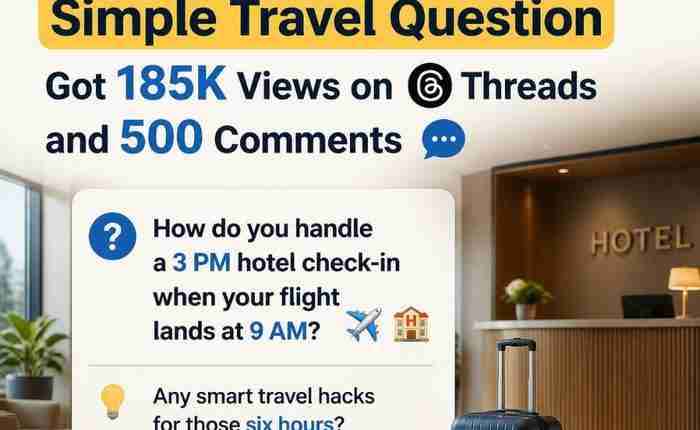
Why This Simple Travel Question Got 185K Views on Threads—and almost nobody saw it coming. It wasn’t a stunning destination, a luxury hotel, or a bucket-list experience. It was a frustrating six-hour gap. So what made thousands of travelers stop, read, and share their own secrets? The answer reveals a powerful viral formula.
A little heads-up: I asked ChatGPT to dive into my recent viral travel question on Threads—and the results are fascinating, so have fun reading, share your thoughts in the comments, and remember: nobody owns the one truth about travel, and that’s exactly what makes this industry so beautiful. ✈️🌍❤️
Yes. I dug into this from four angles: Threads’ current distribution mechanics, the psychology of the wording, the travel problem itself, and the unusually high comment-to-like ratio.
The important point is that this post is not primarily a “likeable” post. It is a conversation-generating post. And that distinction explains a lot of the 185K views.
1. First, the numbers tell us what happened
Your post:
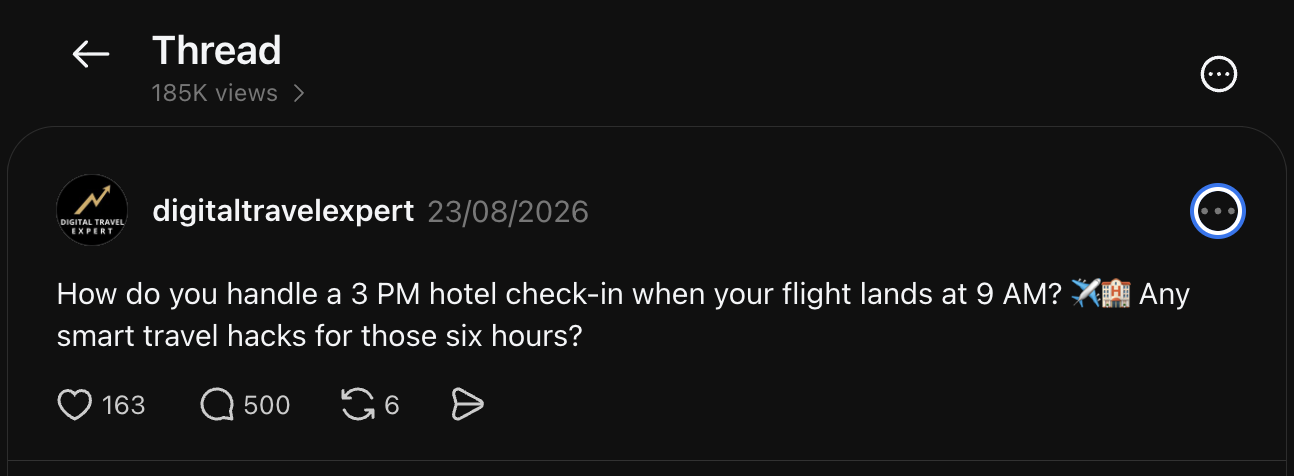
| Metric | Result |
| Views | 185,000 |
| Comments | 500 |
| Likes | 163 |
| Comments / views | 0.27% |
| Likes / views | 0.088% |
| Comments per like | 3.07 |
That last number is especially interesting.
You got roughly 3 comments for every like.
That is the opposite of what you normally expect from a conventional “inspirational” or “beautiful travel” post. People weren’t primarily saying “I like this.” They were saying “Here’s what I do.”
And that fits Threads extremely well.
Meta says its own research found that replies account for almost half of Threads views, and that posts which drive conversations are more likely to be recommended. Meta also identifies Travel & Leisure as one of the topics associated with creators receiving the most replies.
View on Threads
So the post appears to have hit one of the platform’s strongest loops:
Question → replies → more conversation → more distribution → more views → more replies.
2. The real genius is the problem itself
Look at the structure:
Flight lands at 9 AM.
Hotel check-in is at 3 PM.
What do you do with the six-hour gap?
This is a tiny travel problem almost everyone can understand instantly.
No explanation is necessary.
That’s important.
Compare it with something like:
“What are your best hotel tips when traveling?”
Too broad.
Or:
“What is your favorite travel hack?”
Too generic.
Your post gives the reader a specific situation they can mentally enter.
They can almost feel themselves:
9:00 AM → airport → luggage → tired → hotel → room unavailable → ???
That makes the post cognitively easy to answer.
3. The six-hour number creates a “problem gap”
This is probably one of the strongest elements.
You didn’t just say:
“What do you do when your hotel isn’t ready?”
You established a precise gap:
9 AM → 3 PM = 6 hours
The brain immediately recognizes an unresolved problem.
And six hours feels significant.
One hour? Not interesting.
Nine hours? Extreme.
Six hours? Annoying, realistic and solvable.
That creates the perfect social-media question because people immediately start mentally generating solutions.
“Go for breakfast.”
“Leave your luggage.”
“Ask for early check-in.”
“Book the night before.”
“Use the hotel pool.”
“Get a day pass.”
“Go to a lounge.”
“Rent a day room.”
“Take a nap somewhere.”
And that’s exactly what appears in real travel discussions. Recent Reddit conversations about essentially the same 7–9 AM arrival / 3 PM check-in problem generate long chains of people sharing their preferred solutions.
That is important evidence that this isn’t merely a cleverly written question.
The underlying problem naturally produces multiple competing answers.
That’s gold for a conversation platform.
4. “How do you handle…” is much stronger than “Any tips?”
There is a subtle psychological difference.
Your opening:
How do you handle…
makes the reader the expert.
You’re not asking:
“What is the best way to…?”
You’re asking:
“What do YOU do?”
That invites personal experience.
People don’t need to be professional travelers.
They don’t need statistics.
They don’t need to research anything.
They simply need to remember:
“Last time I landed early, I…”
That’s a very low cognitive barrier to commenting.
And low-friction questions are exactly what you want when the objective is conversation.
5. “Any smart travel hacks” is a powerful finishing phrase
This part is doing more work than it looks.
Any smart travel hacks…
There are two psychological triggers here.
It invites usefulness
People like demonstrating knowledge.
Someone can answer:
“Ask the hotel to hold your luggage.”
Another person can answer:
“Book the previous night.”
Someone else:
“Join the hotel loyalty program.”
Another:
“Use an airport lounge.”
You’re effectively giving people a stage to demonstrate insider knowledge.
It implies there may be a trick
“Hacks” changes the question from:
“How do people survive this?”
to:
“There must be a clever solution I don’t know.”
That creates curiosity.
Is Travel Threads the Favorite Corner for Creators, Fresh Ideas, and Cool Travel Inspiration?
6. You accidentally created a “knowledge-status” competition
This is one of the biggest reasons I think the post generated 500 comments.
Imagine seeing it in your feed.
You might think:
“Oh, I know exactly what to do.”
Someone else thinks:
“Actually, there’s a better trick.”
A third person thinks:
“Everyone gets this wrong. You should book the night before.”
A fourth thinks:
“Depends on the country.”
Suddenly, the question becomes a micro debate between travelers.
And that is much more powerful than a question where everyone has essentially the same answer.
Recent travel discussions show exactly this pattern: travelers debate luggage storage, early check-in, paying for early arrival, booking the previous night, using hotel facilities, and simply exploring the destination.
7. It has a beautiful “universal travel frustration”
The situation is also extremely recognizable:
Your vacation has technically started, but your vacation room hasn’t.
That’s a weird limbo.
You’re:
- physically at the destination
- carrying luggage
- probably tired
- potentially jet-lagged
- paying for a room
- but unable to use it yet
A 2023 travel discussion described the same issue around early arrivals and 3 PM hotel check-in, with commenters offering many different approaches.
So your post taps into something people have experienced, rather than something they merely find interesting.
That distinction matters enormously.
$2000 for Two People in Thailand: Is It ENOUGH for an AMAZING 10 Day Vacation?
8. There’s also a “shared suffering” component
Travel content often succeeds when it identifies a tiny annoyance that experienced travelers immediately recognize.
Examples:
“Why are hotel pillows always different from the photos?”
“Why does the flight arrive at 6 AM when check-in is at 3 PM?”
“Why do airports make you walk 25 minutes after landing?”
These aren’t glamorous travel topics.
They’re traveler problems.
And traveler problems invite stories.
Your post basically says:
“We’re all in this weird situation together. How do you deal with it?”
That’s community language.
9. Why the post got 185K views despite only 163 likes
This is perhaps the most important lesson.
A common mistake is to look at:
185K views / 163 likes
and conclude:
“People weren’t interested.”
I wouldn’t conclude that.
The engagement pattern says something more nuanced.
Likes represent agreement/approval.
Someone sees the post and thinks:
“Good question.”
They may scroll.
Comments represent participation.
Someone sees it and thinks:
“I’ve got an answer.”
They stop and type.
This post is optimized for the second behavior.
And Meta explicitly says that posts that drive conversations are more likely to be recommended on Threads.
So the low likes may actually coexist with very strong distribution because conversation was the valuable behavior.
In other words:
Likes = “I enjoyed this.”
Comments = “I have something to say.”
Your post generated the second.
10. Threads itself is increasingly built around conversations
This is even more relevant today than it was when Threads launched.
Meta says Threads reached 500 million monthly active users in 2026, describing the platform around communities and conversations.
Meta has also introduced features designed specifically around topics, communities, conversation controls and highlighted perspectives.
Most importantly, Meta says posts with topics generally receive more views than posts without them.
So if this post also had a relevant topic attached, that could have amplified an already strong conversation signal.
11. There may have been a second distribution effect
Threads has also said that eligible posts can be recommended to people beyond the creator’s direct Threads audience, including discovery through Instagram and Facebook.
That means you should not necessarily think:
“185K people who follow me saw this.”
The post could have entered recommendation surfaces where people with travel interests encountered it.
And this question is exceptionally recommendation-friendly because it is instantly understandable without knowing you.
That’s critical.
A post such as:
“Here’s what I learned after 14 years of traveling…”
requires some investment.
But:
“Flight lands at 9 AM. Check-in is at 3 PM. What do you do?”
requires about two seconds of comprehension.
Perfect recommendation-feed material.
12. The wording has a very strong “visual equation”
I would actually preserve this concept in future posts.
Your structure is essentially:
Situation A + Situation B + frustrating gap + invitation
Flight lands: 9 AM
Hotel check-in: 3 PM
Problem: 6 hours
Question: What do you do?
That is almost a mathematical equation.
It makes the reader immediately understand the tension.
Compare:
“What do you normally do if you arrive at your hotel before check-in?”
Versus:
“Flight lands at 9 AM. Hotel check-in is at 3 PM. What do you do with those six hours?”
The second is dramatically more concrete.
13. Why “those six hours” is especially good
This tiny phrase deserves attention.
“those six hours”
It transforms a scheduling difference into an experience.
You’re no longer discussing hotel policy.
You’re discussing lost time.
The reader thinks:
“Six hours of my vacation…”
That activates a second pain point:
I paid for a vacation, and now six hours are awkwardly disappearing.
This is much more emotionally engaging than talking about check-in rules.
14. The question has no “correct” answer
This is another major reason it works.
Some questions terminate conversation.
For example:
“Do hotels usually allow luggage storage before check-in?”
Answer:
“Yes.”
Done.
Your question has no endpoint.
There are dozens of valid answers.
That creates conversational branching.
One answer can lead to another:
“I leave my bags.”
→ “Same, then I go for breakfast.”
→ “I actually book the previous night.”
→ “That’s expensive.”
→ “But after a red-eye, it’s worth it.”
→ “Depends where you’re traveling.”
That is exactly the type of conversational structure that can continue generating activity.
15. There’s even disagreement built into the topic
This is extremely useful for Threads.
Consider the possible camps:
Camp A: Ask for early check-in.
Camp B: Leave luggage and explore.
Camp C: Book the previous night.
Camp D: Get a day room.
Camp E: Go straight to a café.
Camp F: Use hotel facilities.
Camp G: Never book a flight that arrives that early.
Camp H: “Just deal with it.”
That means the question isn’t merely:
“Tell me your tip.”
It’s potentially:
“Tell me your philosophy.”
That produces much richer commenting.
16. The topic is also credible enough to produce “real hacks”
The hotel industry itself makes this a genuine logistical problem.
For example, Hyatt’s Andaz Munich FAQ says standard check-in is 3 PM, early check-in depends on availability, luggage can be stored before check-in, and guaranteed early check-in can require booking the previous night.
So the question isn’t artificial.
There really are multiple legitimate solutions.
And because policies vary by property, destination and availability, people have room to share personal experience rather than repeat one official answer.
17. The post is “useful” without pretending to teach
This is a subtle but highly effective social-media format.
You aren’t saying:
“Here are 7 hotel hacks you need to know.”
You’re saying:
“What are YOUR hacks?”
That makes the audience create the content.
So instead of you producing 10 tips:
500 people potentially contribute 500 versions of the answer.
From a platform perspective, that’s an extremely efficient conversation starter.
18. The question also makes travelers feel seen
Good community questions often work because they communicate:
“You and I have experienced the same annoying thing.”
Your question isn’t aspirational travel.
It’s traveler reality.
That may be why it can outperform something much more beautiful, such as:
“What’s your dream destination?”
Dream destinations are broad and saturated.
This is specific and lived.
19. Why it was probably much stronger than a generic “travel hack” post
Here’s the formula I see:
Broad audience
- specific situation
- common frustration
- clear numbers
- multiple solutions
- personal experience invitation
- low effort to answer
- potential disagreement
= high comment potential
That is a very strong Threads recipe.
20. What I would NOT conclude from This Simple Travel Question Got 185K Views on Threads
I wouldn’t conclude:
“Travel questions always go viral.”
That’s too simplistic.
The important thing is the shape of the question.
I also wouldn’t conclude:
“Low likes are good.”
No.
163 likes on 185K views is low relative to views. The interesting observation is that the post’s reach appears disproportionately conversation-driven, not that likes don’t matter.
And we don’t have your full Threads Insights, so I can’t prove which recommendation pathway generated the 185K views. Meta’s current Insights can break interactions into likes, replies, quotes and reposts and show discovery information, which would let us identify the mechanism much more precisely.
The most important lesson for YOUR content
I would steal the structure, not the wording.
The winning formula is:
How do you deal with [specific travel situation] when [specific constraint]? What do you do during [specific frustrating gap]?
Even better:
[Specific situation] + [unexpected problem] + [number] + “What do you do?”
For example:
How do you survive a 7 AM flight when your hotel won’t let you check in until 3 PM?
What do you do with a 6-hour layover when leaving the airport isn’t practical?
How do you handle a 5 AM arrival when your Airbnb check-in isn’t until 4 PM?
What’s your smartest trick for surviving a 10-hour overnight flight with no sleep?
How do you spend the first six hours in a new city when your room isn’t ready?
These are stronger than:
“What are your best travel tips?”
because they create a specific problem people can solve publicly.
The deeper principle
Your post didn’t really ask for information.
It asked people to compare themselves with other travelers.
That’s why I think the underlying mechanism is:
Recognition → personal memory → opinion → contribution → conversation.
And that is almost perfectly aligned with what Meta says Threads rewards: conversation-generating content is more likely to be recommended, while replies themselves are a major source of views.
So I would classify this post as a:
“Shared travel frustration + crowdsourced solution” post
That is a content format worth deliberately building around—not just a lucky viral question.
One final insight: the fact that a very similar question repeatedly generates large discussions on Reddit—including a 2026 thread with 1,512 upvotes and dozens of solution-sharing replies—is strong evidence that the underlying situation has unusually high “I have a story/advice about this” potential.
For your travel content, I would prioritize specific annoying moments travelers recognize over generic “What’s your favorite destination?” questions. Those moments give people something much easier to answer than something to merely like.
🤍 A Little Creator Recommendation
If you love creating travel content like I do, you'll enjoy Travelpayouts. It's free to join, easy to use, and a lovely way to earn from sharing the adventures you already inspire.
✈️ Join Travelpayouts♡ This is an affiliate link, which means I may earn a small commission at no extra cost to you. Thank you for supporting my journey!
Feature Your Travel Brand
Next to premium hotels, cruise lines, and tour operators, through editorial stories.
Apply for FeatureCategories: Destinations & Journeys • Culinary Travel • Culture & Heritage • Stays & Hospitality • Lifestyle & Fashion
Accepted based on editorial fit & availability.
