
Originally published on September 18, 2026 | Last updated on September 18, 2026
The Biggest Travel Problems Bothering U.S. Consumers are reshaping how people plan, book, and experience travel. Rising costs, hidden fees, disruptions, service concerns, and changing technology are pushing travelers to demand greater transparency, flexibility, value, and trust.
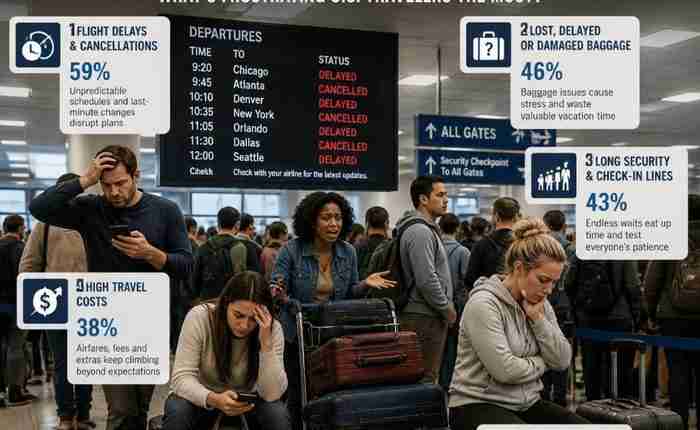
For U.S. travelers, the problem with travel in 2026 is not simply that vacations are expensive.
It is that travel has become harder to understand.
Consumers are dealing with higher prices, complicated fees, uncertain cancellation policies, changing airline schedules, inconsistent service, crowded airports, technology that sometimes creates as much friction as it removes, and an increasingly complicated relationship with artificial intelligence.
At the same time, Americans clearly still want to travel.
That contradiction is one of the most important stories in travel and hospitality right now.
Deloitte’s 2026 Summer Travel Survey found that only 45% of Americans planned a summer vacation involving paid lodging, the lowest level in six years. Yet among those who were traveling, intended spending on their longest summer trip averaged $4,069—17% higher than the previous year.
In other words, many consumers are not necessarily abandoning travel.
They are becoming more selective about when, where and how they spend their money.
This article examines the biggest consumer pain points shaping the U.S. travel and hospitality market in 2026—and what they reveal about where the industry is heading.
1. The Price of Travel Has Become More Difficult to Predict
Perhaps the biggest frustration for travelers is not simply high prices.
It is price uncertainty.
A traveler may see an attractive airline fare or hotel rate, only to discover that the final price changes after baggage, seat selection, resort fees, cleaning fees, taxes, transportation and other charges are added.
This makes comparing travel products surprisingly difficult.
The result is what could be called travel price fatigue.
Consumers are spending more time asking:
- What is the actual price?
- What is included?
- What isn’t included?
- Which fees are mandatory?
- What happens if I cancel?
- Is the cheaper option actually cheaper?
The problem is significant enough that the Federal Trade Commission’s rule on unfair or deceptive fees requires covered short-term lodging businesses to disclose mandatory fees as part of the advertised total price. The rule took effect May 12, 2025.
The issue is still very much alive.
In July 2026, the FTC announced a proposed $35 million settlement with Hopper over allegations involving undisclosed or pre-selected fees and representations concerning certain travel products. The allegations included fees associated with its travel booking services and claims about VIP Support and Price Freeze products.
For consumers, the broader lesson is simple:
The displayed price is no longer enough. Travelers want to know the final price before they commit.
The hotel industry’s perspective
The American Hotel & Lodging Association argues that resort and amenity fees are disclosed before booking and says approximately 6% of hotels currently charge resort fees. It also supports standardized fee disclosure across hotels, OTAs, metasearch platforms and short-term rentals.
That distinction matters.
The consumer frustration isn’t necessarily about whether a fee exists.
It is about whether the traveler can compare the real cost easily.
For hospitality brands, price transparency is increasingly becoming part of the customer experience rather than merely a compliance issue.
2. Airline Fees Are Changing the Meaning of an “Airfare”
Airfare used to be relatively easy to understand:
Ticket = price of transportation.
Today, travelers may encounter separate charges for:
- Checked baggage
- Seat selection
- Preferred boarding
- Premium seating
- Changes
- Certain cancellation options
- Wi-Fi
- Food and beverages
- Other ancillary services
The challenge is that consumers increasingly evaluate airlines based on the total trip cost, not the advertised base fare.
And baggage remains a particularly visible pain point.
According to U.S. Department of Transportation data reported in September 2026, U.S. airlines mishandledmore than 1.12 million checked bags during the first six months of 2026, or roughly 0.5 mishandled bags per 100 enplaned.
That creates a psychologically difficult equation for passengers:
Pay more for the service—and still worry about whether the service will work.
The DOT’s monthly Air Travel Consumer Reports track delays, baggage problems, wheelchair and scooter handling, oversales and consumer complaints.
And the complaint data reveal another important issue: refunds and flight schedules remain major sources of consumer friction.
In April 2026, refund complaints were the largest complaint category recorded in the DOT’s report, followed by flight-schedule complaints and baggage/luggage complaints.
3. Cancellations and Refunds Remain a Trust Problem
Travel is fundamentally different from many consumer purchases because the customer is buying something that happens in the future.
That creates uncertainty.
A flight can be cancelled.
A hotel can become unavailable.
A traveler can become sick.
A destination can experience disruption.
An airline can change a schedule.
And the consumer then has to navigate a maze of policies.
The U.S. Department of Transportation’s inspector general found that the growth in flight delays, cancellations and refund requests following the pandemic created a substantial increase in airline refund complaints.
This matters because refund friction doesn’t simply create an individual customer-service problem.
It can undermine trust in the entire travel ecosystem.
Consumers increasingly want:
Clear cancellation terms + easy cancellation + predictable refunds.
Not:
“Contact us and we’ll see what we can do.”
4. Hotel Guests Are Asking a More Basic Question: “What Am I Actually Paying For?”
Hotel prices remain another source of tension.
PwC’s 2026 U.S. Hospitality Directions report projects U.S. hotel RevPAR growth of 2.9% in 2026, with demand expected to grow faster than supply.
That suggests continued demand.
But demand does not mean consumers are insensitive to price.
Deloitte’s research shows that affordability is actively influencing whether Americans travel at all. Among Americans earning below $100,000, 51% said travel spending is one of the first areas they cut when expenses rise.
At the hotel level, guest expectations are also evolving.
J.D. Power’s hotel research has found that guests are paying close attention to value, room condition, cleanliness and amenities such as smart TVs and hotel mobile apps.
That produces an important shift:
Consumers don’t necessarily demand the cheapest hotel. They want the hotel that makes the price feel justified.
That distinction is crucial.
A $250 room can feel expensive.
A $250 room with an excellent location, clean room, reliable Wi-Fi, easy check-in, good service and transparent fees may feel like better value.
5. The “Value” Problem Is Becoming More Important Than the “Luxury” Problem
Travel consumers are increasingly asking whether an experience is worth the money.
KPMG’s 2026 consumer survey found that 93% of respondents reported experiencing higher costs of living over the previous year. Thirty-eight percent said they were switching to more affordable alternatives for travel.
This doesn’t mean Americans have stopped spending on experiences.
Quite the opposite.
The evidence suggests a form of selective splurging.
Consumers may economize on transportation and spend more at the destination.
They may choose a shorter trip but stay somewhere better.
They may travel fewer times but spend more on one important experience.
They may select a midscale hotel instead of a luxury property but prioritize location and reviews.
Travel businesses therefore need to think beyond:
“How much can we charge?”
The more important question is:
“Can the customer understand why this costs what it costs?”
6. Travel Consumers Are Becoming More Strategic About Where They Cut Costs
The current consumer isn’t necessarily a budget traveler.
They are often a value optimizer.
KPMG found that hotels remained the preferred lodging choice for 55% of travelers in its summer 2026 survey, while 34% said they were saving money by staying with family or friends.
Deloitte’s research similarly indicates that travel behavior is becoming more conservative for some consumers, including reductions in trip frequency, length, distance and accommodation class.
This creates several emerging behaviors:
Shorter trips
Rather than eliminating travel entirely, consumers may reduce the number of nights.
Fewer trips
A household that previously took four vacations may take two.
Shoulder-season travel
Consumers increasingly look for periods when prices and crowds are lower.
Domestic substitutions
Some travelers choose destinations closer to home when international travel becomes more complicated or expensive.
Experience prioritization
Some travelers cut accommodation costs to preserve spending for activities.
The result is a travel market increasingly divided between those who can absorb higher prices and those who have to redesign the trip.
7. Customer Service Is Becoming a Competitive Differentiator Again
Digital travel has made booking dramatically easier.
But it has not necessarily made problem solving easier.
When everything goes according to plan, consumers are happy to use:
- Apps
- Chatbots
- Self-service
- Automated check-in
- Digital keys
- Online cancellations
- AI assistants
The problem appears when something goes wrong.
A cancelled flight is not an ordinary transaction.
A lost suitcase is not an ordinary transaction.
A hotel room that isn’t available at midnight is not an ordinary transaction.
That’s when customers want a human being who can solve the problem.
The continuing importance of customer service is particularly visible in the travel sector because failures happen at emotionally stressful moments.
This creates a paradox:
Travel companies are automating more of the customer journey at exactly the time consumers may need human intervention most.
The winning customer-service model may therefore be neither fully human nor fully automated.
It may be:
AI for speed + humans for exceptions.
8. AI Is Becoming Part of the Travel Consumer Journey
This may be the most consequential change of all.
Travelers increasingly use generative AI to research destinations, compare options and build itineraries.
PwC reported in 2026 that 44% of consumers surveyed often or always use AI tools to compare prices and look for discounts, while 42% use AI to research destinations and travel options. One-third reported using AI agents or bots to book parts of their trips.
KPMG found that generative-AI use for trip planning had nearly doubled over two years, reaching 27% in its 2026 survey.
And the technology is moving beyond recommendations.
In August 2026, The Digital Travel Expert reported on Google’s testing of AI-powered hotel booking, a development that illustrates the shift from AI answering travel questions to AI participating in transactions.
For readers interested in the technology behind this change, see:
Agentic AI Travel Is the Next Big Shift in Travel Technology
This creates a new consumer concern:
Can I trust the AI?
Travelers may increasingly ask:
- Did the AI actually find the cheapest option?
- Is the hotel information current?
- Are the reviews reliable?
- Did it understand the cancellation policy?
- Did it include all fees?
- Why did it choose this hotel?
- Who is responsible if the booking is wrong?
The travel industry is therefore entering an era where AI transparency becomes part of consumer trust.
9. Consumers Don’t Want Another Technology Layer—They Want Less Friction
Technology is useful when it removes work.
It becomes frustrating when it adds work.
Travelers already navigate:
- Airline apps
- Hotel apps
- OTA apps
- Airport apps
- Loyalty programs
- Digital wallets
- QR codes
- Digital boarding passes
- Chatbots
- Authentication systems
The future isn’t necessarily about adding more technology.
It’s about connecting existing technology.
A traveler doesn’t want five separate systems.
They want to say:
“My flight is delayed. Find me an alternative, tell my hotel, update my rental car and explain what I need to do.”
That’s the real promise of agentic travel.
The Digital Travel Expert has also explored this broader transformation in its coverage of Google’s AI hotel-booking experiments:
Google Tests AI Hotel Booking as Travel Industry Enters a New Bold AI Era
10. Privacy Is Becoming a Travel Consumer Issue
AI-powered personalization requires data.
Travel companies increasingly want to know:
- Where travelers go
- What they search
- What they book
- What they spend
- Which hotels they prefer
- What loyalty benefits they use
- What destinations interest them
- Which offers they respond to
That information can create better personalization.
But it also creates a trust question:
How much does the travel company know about me—and how is that information being used?
Deloitte’s 2026 travel industry outlook identifies privacy, consent, profiling, automated decision-making and evolving U.S. state privacy rules as important issues for travel companies deploying generative AI and personalized offers.
For consumers, privacy is becoming less abstract.
It is increasingly connected to the prices and recommendations they see.
11. Travelers Are Becoming More Sensitive to Disruptions
Travel disruption has always existed.
What has changed is the consumer’s tolerance for it.
Passengers increasingly expect real-time information when:
- Flights are delayed
- Connections change
- Gates move
- Bags disappear
- Hotels change reservations
- Weather disrupts itineraries
The DOT’s 2026 reporting infrastructure now provides more granular consumer complaint information, including categories such as disability, discrimination and other consumer issues.
And the operational side remains significant.
Baggage mishandling continues to affect more than a million bags annually across U.S. airlines, based on the first-half 2026 data.
Consumers increasingly expect travel companies to provide proactive communication rather than reactive explanations.
12. Accessibility Is Still an Important Unresolved Consumer Issue
For travelers with disabilities, travel friction can be much more consequential.
The DOT continues to track wheelchair and scooter mishandling as part of its Air Travel Consumer Reports.
In 2026, DOT also extended enforcement discretion for certain provisions of its wheelchair-accommodation rule while continuing work on accessibility requirements, including accessible lavatories on single-aisle aircraft.
This illustrates an important point:
For many travelers, accessibility isn’t an optional feature.
It is the difference between:
“I can travel.”
and
“I can travel without unacceptable risk or uncertainty.”
The hospitality industry therefore faces a broader challenge: accessibility needs to be treated as part of the core customer journey rather than a specialized add-on.
13. International Travel Has an Additional Layer of Uncertainty
U.S. travelers are also navigating a more complicated international environment.
The travel industry has reported declining international inbound traffic to the United States in 2026, with Reuters reporting that overseas visitors were down 4.7% through July compared with the prior year. Industry representatives have pointed to factors including visa wait times, airfare prices and changing travel restrictions.
For U.S. consumers, international uncertainty can influence destination selection in the opposite direction:
If international travel becomes complicated, domestic travel becomes comparatively attractive.
PwC’s 2026 hospitality analysis also notes that geopolitical uncertainty may be redirecting some would-be international trips toward domestic destinations.
This doesn’t mean travelers are abandoning international tourism.
It means uncertainty has become another variable in the booking decision.
14. Travelers Are Increasingly Asking: “Can I Trust the Review?”
Reviews remain one of the most important sources of information in travel.
But AI-generated content, manipulated reviews, influencer marketing and increasingly sophisticated digital advertising are making authenticity more difficult to assess.
Consumers have to distinguish between:
- Genuine guest reviews
- Sponsored content
- Influencer recommendations
- Affiliate content
- AI-generated descriptions
- Promotional hotel copy
- Algorithmically generated recommendations
That makes editorial trust increasingly valuable.
Travelers don’t just need more information.
They need better information.
The Digital Travel Expert’s approach to external linking reflects this broader principle: authoritative external sources can help establish context and credibility when used appropriately.
15. The Biggest Consumer Shift: From “Cheap” to “Worth It”
Put all these trends together and a larger pattern emerges.
The U.S. travel consumer of 2026 isn’t necessarily asking:
“What’s the cheapest trip?”
They are increasingly asking:
“What’s the best use of my limited travel budget?”
That changes everything.
A traveler may pay more for:
- A nonstop flight
- A better hotel location
- Flexible cancellation
- Reliable customer service
- A larger room
- A better experience
- Greater convenience
- More trustworthy booking conditions
But they are less willing to pay more simply because the travel company has complicated the purchasing process.
The 2026 U.S. Travel Consumer Pain-Point Map
| Consumer concern | What travelers are experiencing | Why it matters |
| Affordability | Higher household and travel costs | Some consumers reduce or eliminate trips |
| Price transparency | Fees and add-ons complicate comparison | Trust suffers when final prices differ from expectations |
| Airline reliability | Delays, cancellations and baggage issues | Disruptions can affect the entire trip |
| Refunds | Consumers may have to navigate complicated processes | Creates a major customer-service pain point |
| Hotel value | Higher room costs and additional charges | Guests increasingly evaluate value, not just price |
| Customer service | Automated systems can struggle with unusual problems | Human support remains important during disruptions |
| AI trust | AI increasingly influences booking decisions | Consumers need confidence in recommendations |
| Privacy | More personalization requires more data | Creates concerns around profiling and consent |
| Accessibility | Travelers with disabilities can face additional barriers | Basic access remains a significant travel issue |
| Authenticity | More AI-generated and promotional content | Consumers need trustworthy information |
| Uncertainty | Economic, geopolitical and operational disruption | Encourages flexible and cautious booking |
| Overcrowding | Popular destinations can create congestion and lower perceived value | Experience quality can decline even when demand is strong |
What This Means for Travel and Hospitality Businesses
The consumer research points toward a very different competitive environment.
The companies that understand the traveler aren’t necessarily those that offer the lowest price.
They are the ones that remove uncertainty.
That means five things are becoming increasingly important.
1. Make the final price easy to understand
Don’t make customers calculate the real cost themselves.
2. Make policies understandable
Cancellation, refund, baggage and change policies should be written for humans—not lawyers.
3. Use AI to reduce friction
AI should help consumers complete tasks, not create another layer of complexity.
4. Keep humans available for exceptions
When something goes wrong, customers need escalation paths.
5. Prove value
The question isn’t simply whether your product is affordable.
It’s whether customers understand why it is worth paying for.
For travel businesses looking at the marketing implications, Digital Travel Expert’s guide to customer pain points offers a useful companion piece:
6 Best Solutions To Customer Pain Points in Travel Marketing
And for companies trying to turn these insights into a digital strategy:
Best of Digital Marketing in the Travel Industry For Owners
The Next Competitive Advantage in Travel May Be Simplicity
Travel has never been a simple product.
A single vacation can involve an airline, airport, hotel, OTA, rental car company, restaurant, tour operator, payment provider and dozens of other services.
Technology was supposed to make this complexity disappear.
Instead, consumers sometimes experience digital complexity layered on top of physical complexity.
That is the opportunity.
The next generation of travel companies may compete not simply on price, loyalty points or luxury.
They may compete on how little work they require from the traveler.
The winning experience could look something like this:
Find the trip.
Understand the total price.
Book it.
Change it when necessary.
Get help when something goes wrong.
Know exactly what happens next.
No surprises.
No unnecessary friction.
No endless customer-service maze.
And increasingly, perhaps, no need to visit ten different websites.
Final Takeaway on The Biggest Travel Problems Bothering U.S. Consumers in 2026
The biggest problem facing U.S. travel consumers in 2026 isn’t that they don’t want to travel.
The evidence suggests they still strongly value travel and experiences.
The problem is that consumers increasingly want their money, time and attention to produce a predictable result.
Deloitte’s research shows a travel market under pressure from affordability. KPMG finds consumers adapting their travel choices rather than abandoning experiences altogether. PwC sees continued lodging demand alongside rapidly changing AI-driven booking behavior. Meanwhile, DOT and FTC data demonstrate that refunds, fees, baggage, schedules and consumer protection remain important sources of friction.
The message for the travel industry is therefore straightforward:
Consumers don’t necessarily need travel to become cheaper. They need travel to become easier to understand.
And as AI increasingly becomes the interface between consumers and travel companies, the brands that provide transparent prices, trustworthy information, reliable service and genuinely useful technology will be better positioned to earn consumer trust.
The future of travel may be powered by artificial intelligence.
But the thing consumers are ultimately looking for remains remarkably human:
confidence that the trip they paid for will be the trip they actually experience.
Further Reading from The Digital Travel Expert Hub
- Agentic AI Travel Is the Next Big Shift in Travel Technology
- Google Tests AI Hotel Booking as Travel Industry Enters a New Bold AI Era
- 6 Best Solutions To Customer Pain Points in Travel Marketing
- Best of Digital Marketing in the Travel Industry For Owners
- Worth-Following Travel Trends Beyond Seasons
- How External Links in Travel SEO Inspire Niche Authority
Research note: Survey results cited above come from different field dates, sample populations and methodologies. They should not be treated as directly interchangeable measures of the same population. Operational and regulatory data are presented separately from consumer sentiment where possible.
🤍 A Little Creator Recommendation
If you love creating travel content like I do, you'll enjoy Travelpayouts. It's free to join, easy to use, and a lovely way to earn from sharing the adventures you already inspire.
✈️ Join Travelpayouts♡ This is an affiliate link, which means I may earn a small commission at no extra cost to you. Thank you for supporting my journey!
Feature Your Travel Brand
Next to premium hotels, cruise lines, and tour operators, through editorial stories.
Apply for FeatureCategories: Destinations & Journeys • Culinary Travel • Culture & Heritage • Stays & Hospitality • Lifestyle & Fashion
Accepted based on editorial fit & availability.
